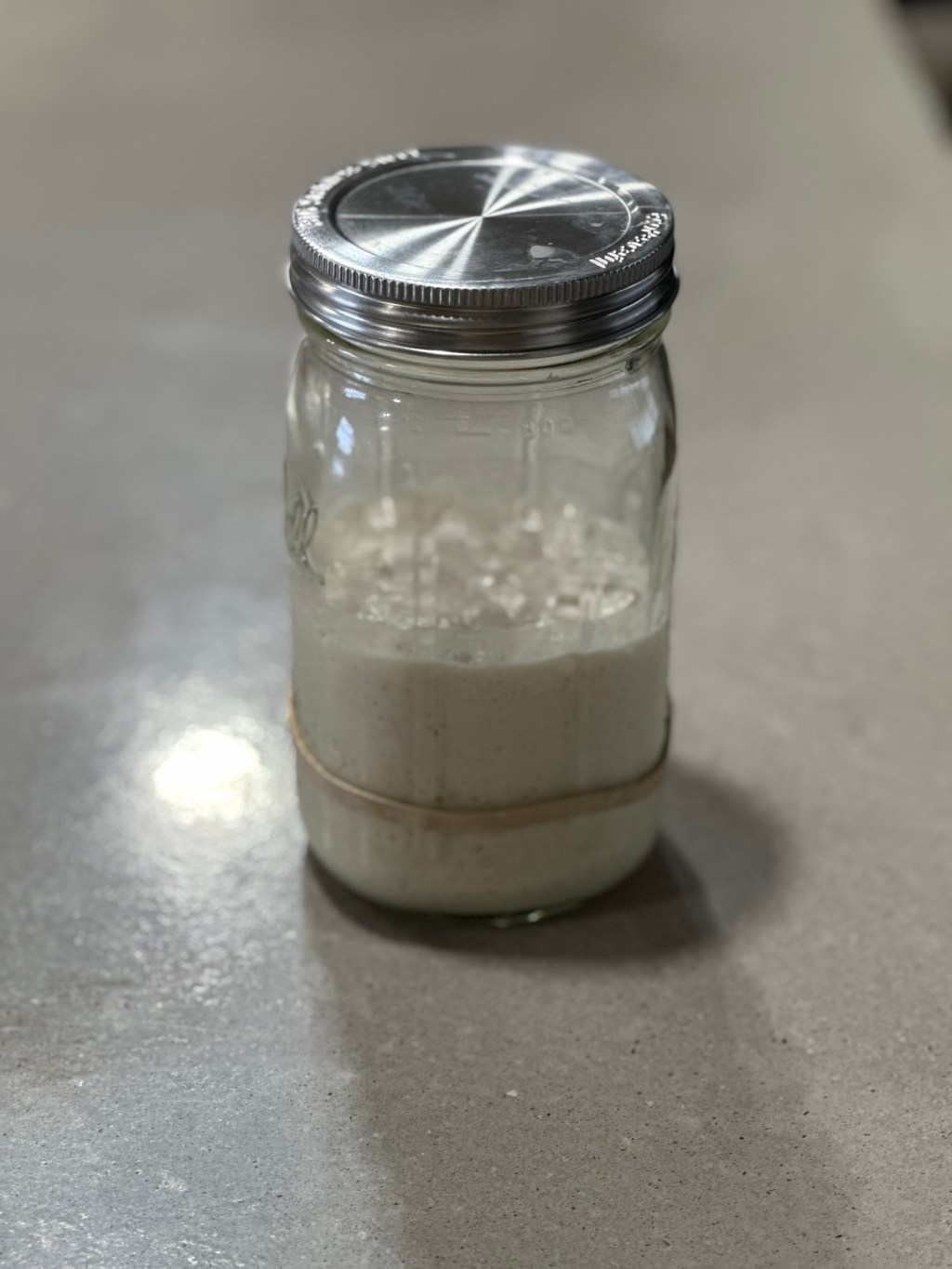
If you’ve started sourdough, you’ve probably asked yourself at least once:
“How do I not kill this thing?”
Good news — sourdough starters are far more resilient than people think.
I keep mine at 100% hydration, store it in the fridge between uses, and bake with it 1–2 times per week. It’s simple, sustainable, and low maintenance.
Let’s walk through exactly how to keep your starter alive — long term.
What Does 100% Hydration Mean?
100% hydration simply means: Equal weight of flour and water. Not equal volume — equal weight.
For example:
- 50 g water + 50 g flour
- 100 g water + 100 g flour
- 4 oz water + 4 oz flour
At 100% hydration, your starter will be thick but stirrable — like pancake batter.
How I Maintain My Starter (Fridge Method)
After feeding and letting it become active, I store my starter in the refrigerator.
Since I bake 1–2 times per week, here’s what that looks like:
Typical Feeding
- 50 g starter (1.8 oz | about ¼ cup loosely measured)
- 100 g water (3.5 oz | about ½ cup)
- 100 g flour (3.5 oz | about ¾ cup loosely measured)
This is a 1:2:2 ratio.
Let it rise at room temp until active (usually around 8 hours), then store in the fridge.
How Long Can Starter Stay in the Fridge?
If you bake weekly:
- Feed once per week.
If you bake every other week:
- Feed every 10–14 days.
If life gets busy?
Healthy starters can survive:
- 3–4 weeks with no feeding
- Some people report 2–3 months in the fridge
I’ve heard from friends who’ve left theirs in the fridge for 2–3 months, then fed it a couple of times at room temperature and brought it right back to life. If it develops hooch (liquid on top), that’s okay. Stir it in or pour it off and feed.
If it smells like acetone or nail polish remover — it’s just hungry.
If you see pink, orange, or fuzzy mold — discard and start fresh.
Understanding Feeding Ratios (The Math Made Simple)
Feeding ratios are written like this:
Starter : Flour : Water
1:1:1
- 50 g starter
- 50 g flour
- 50 g water
Faster fermentation. Smaller rise window. Rises faster and falls faster.
1:2:2 (My Usual)
- 50 g starter
- 100 g flour
- 100 g water
Balanced and predictable.
1:5:5
- 20 g starter
- 100 g flour
- 100 g water
Slower fermentation. Great for warm kitchens or a wider time range for use.
1:10:10
- 10 g starter
- 100 g flour
- 100 g water
Very slow, strong feeding. Good for strengthening a weak starter.
Higher ratios = slower fermentation = longer peak window.
What About Discard?
When feeding, you remove some starter to keep it from growing endlessly.
Instead of throwing it away, I collect mine in a jar in the fridge.
Yes — from the same jar.
Yes — for months.
Because discard is unfed starter, it becomes more acidic over time, but that acidity actually works well in many recipes.
How Long Is Discard Good For?
In the fridge:
- Easily 1–2 months
- Often longer if it smells clean and tangy
- No mold, no off colors
Stir occasionally if liquid forms.
What to Watch For (And What’s Totally Normal)
Sourdough starters look… alive. Because they are.
Here’s how to know what’s fine — and what’s not.
Hooch (Liquid on Top)
You may see a gray, brown, or clear liquid forming on top of your starter.
That’s called hooch. It simply means your starter is hungry. You can:
- Stir it back in for a more tangy flavor
- Or pour it off before feeding
Either way is fine. Hooch is not mold. It’s just fermentation byproduct.
Strong Smell (Acetone or Nail Polish Remover)
If your starter smells sharp, like acetone, that just means it needs food.
Feed it a couple of times at room temperature using a higher ratio (like 1:5:5 or 1:10:10), and it should bounce back.
Thin or Sluggish Texture
If it looks watery or isn’t rising well it may just be cold from the fridge or it may need 1–2 room temperature feedings to strengthen. Most starters recover quickly.
Mold (This Is When You Toss It)
Mold is the one thing that means it’s time to discard and start fresh.
Look for:
- Pink streaks
- Orange spots
- Fuzzy green, black, or white growth
- Anything that looks hairy or powdery
If you see mold, do not try to scrape it off.
Discard the entire starter and sanitize the jar before starting again.
Normal Starter Behavior
Totally normal things:
- Bubbles
- Slight separation
- A strong sour smell
- A layer of hooch
- Rising and falling
Starters are active cultures — they aren’t meant to look sterile.
5 Things You Can Make With Discard
- Sourdough pancakes or waffles
- Pull apart garlic bread
- Biscuits
- Banana bread
- Noodles
Discard adds flavor, tenderness, and depth — without needing a full rise.
How to Dehydrate Your Starter (Backup Insurance)
Every sourdough baker should do this once.
It takes 10 minutes and gives you peace of mind.
To Dehydrate:
- Feed your starter and let it become active.
- Spread a thin layer on parchment paper.
- Let it air dry completely (24–48 hours).
- Break into flakes.
- Store in an airtight jar.
No heat needed — just room temperature.
To Rehydrate:
- Weigh 10 g dried starter flakes (0.35 oz).
- Add 10 g warm water.
- Let sit until softened.
- Feed 1:1:1.
- Repeat feedings for a few days until active.
It comes back surprisingly well.
Tools That Make This Easier
A digital kitchen scale removes all the guesswork.
There are also sourdough starter kits available that include:
- A marked jar
- Cloth cover
- Thermometer
- Feeding ratio guides
- Spatulas and scrapers
They make the math much simpler if you’re just starting out. Extra simple if you also get a kitchen scale.
Amazon Affiliate Disclosure
As an Amazon Associate, I earn from qualifying purchases. This means if you choose to purchase through links I share, I may receive a small commission at no additional cost to you. I only recommend products I personally use or believe add value to your kitchen.
Final Thoughts
You don’t need to overcomplicate sourdough.
Feed it.
Use it.
Store it in the fridge.
Revive it when needed.
Dry some as backup.
Starters are resilient. Much more than we give them credit for.
If you bake 1–2 times per week like I do, the fridge method keeps everything simple and sustainable.
And once you understand the ratios — it stops feeling intimidating.
It just becomes part of your rhythm.
 Rustic Roots & Modern Finds
Leave a comment